

Few travel experiences rival the transformative power of Morocco desert tours journeys that transport travelers from bustling imperial cities through dramatic mountain passes, ancient earthen kasbahs, spectacular river gorges, and verdant palm valleys before culminating in encounters with some of Earth’s most magnificent desert landscapes. Morocco occupies a unique geographical position where the Sahara Desert meets the Atlas Mountains within days of travel, creating compressed diversity that allows single journeys to encompass landscapes, cultures, and experiences typically requiring separate continent-spanning expeditions. The country’s well-developed desert tourism infrastructure, combined with authentic cultural encounters, extraordinary natural beauty, and accommodation ranging from authentic Berber camps to glamorous luxury properties, ensures Morocco desert tours deliver transformative experiences resonating long after travelers return to everyday routines.
The Saharan Heritage: Ancient Routes, Modern Adventures
Morocco’s relationship with the Sahara Desert extends across millennia, shaped by trans-Saharan trade routes that connected sub-Saharan Africa with Mediterranean civilizations. These ancient corridors carried gold, salt, ivory, and enslaved people across seemingly impassable desert barriers, generating wealth that funded the magnificent cities, palaces, and mosques defining Morocco’s architectural heritage today. The fortified ksour (plural of ksar) and kasbahs dotting southern Morocco’s landscape served as crucial way stations and trading posts along these routes, their earthen architecture and strategic positions revealing the sophisticated logistical thinking required to maintain commerce across challenging environments.
Contemporary Morocco desert tours follow paths ancestral caravans traversed, creating profound historical connections as travelers navigate identical terrain between identical waypoints using dramatically different transportation. The continuity between ancient trading routes and modern tourist circuits reveals how geography shapes human movement across generations the High Atlas passes, Draa Valley corridors, and Ziz Valley oases that sustained medieval traders continue guiding contemporary explorers toward the same desert landscapes.
The Berber and Tuareg peoples maintaining cultural traditions within desert regions add human dimensions to geographical wonder. Their knowledge systems reading landscapes for water sources, navigating by stars, predicting weather from wind and cloud patterns, identifying edible desert plants represent extraordinary intellectual achievements accumulated over centuries of desert existence. Quality Morocco desert tours incorporate encounters with these communities, creating educational experiences transforming scenic adventures into genuine cross-cultural exchanges.
Gateway Cities and Route Beginnings
Most Morocco desert tours originate from Marrakech or Fes the two imperial cities providing convenient international connections and comprehensive tourism infrastructure. Each origin creates distinct touring experiences, with Marrakech routes emphasizing the High Atlas crossing and Valley of Roses while Fes routes traverse Middle Atlas cedar forests and the spectacular Ziz Valley.
The Marrakech-based route immediately confronts travelers with dramatic transitions. Departing the Red City’s intense urban energy, vehicles ascend through increasingly sparse vegetation toward Tizi n’Tichka Pass at 2,260 meters, where temperatures drop noticeably and views expand across mountain ranges extending in every direction. This High Atlas crossing establishes the journey’s pattern of dramatic transitions landscapes transforming completely within hours as elevation, rainfall, and vegetation change fundamentally.
Fes-originating tours traverse different but equally spectacular terrain. The route passes through Azrou’s cedar forests where Barbary macaques inhabit native cedar stands, before climbing through Midelt positioned between High and Middle Atlas ranges and continuing toward the Ziz Valley. This magnificent palm oasis, stretching twenty kilometers through otherwise barren landscapes, demonstrates how water transforms desert environments while sustaining traditional communities along ancient trade routes.
Iconic Stops and Cultural Encounters
Regardless of origin or routing, quality Morocco desert tours incorporate essential stops that collectively reveal the country’s extraordinary cultural and natural diversity.
Aït Benhaddou stands as Morocco’s most photogenic historical monument a UNESCO World Heritage Site where traditional earthen architecture cascades down hillsides creating harmonious geometric compositions against desert backdrops. This remarkably preserved ksar continues attracting international film productions “Gladiator,” “Lawrence of Arabia,” “Game of Thrones” while remaining authentically inhabited by families maintaining traditional lifestyles within ancient structures. Walking through narrow passages between towering earthen walls, ascending to upper terraces for panoramic desert views, and understanding the sophisticated design principles enabling buildings to survive for centuries without modern materials reveals architectural intelligence often underappreciated in vernacular construction.
Ouarzazate, the so-called “Hollywood of Africa,” serves as gateway between mountain Morocco and desert territories. The town’s film industry significance reflects the surrounding landscapes’ extraordinary cinematic qualities dramatic lighting, pristine environments, and architectural authenticity attracting major productions seeking authentic historical settings. The nearby Kasbah Taourirt, once the most important Glaoui property in southern Morocco, demonstrates traditional palace architecture with intricate decorative elements and labyrinthine interior passages.
The Dades Valley and Todra Gorge create parallel geological dramas where limestone canyons carved through million-year-old rock formations create passages of overwhelming scale. Todra Gorge’s narrowest section barely ten meters wide with 300-meter sheer walls creates natural cathedrals where light enters as narrow strips while permanent streams sustain unexpected vegetation. International rock climbers tackle challenging routes while overwhelmed tourists simply absorb the geological spectacle.
Erg Chebbi and Merzouga: The Desert’s Magnificent Heart
Erg Chebbi represents Morocco desert tours’ ultimate destination a magnificent sand sea rising dramatically from flat surrounding terrain, its dunes exceeding 150 meters creating horizons of pure golden beauty. The approach to Merzouga, the small town positioned at Erg Chebbi’s edge, builds anticipation through gradually changing landscapes rocky hamada giving way to scattered dunes before the full revelation of the great erg emerging like a mirage made permanent reality.
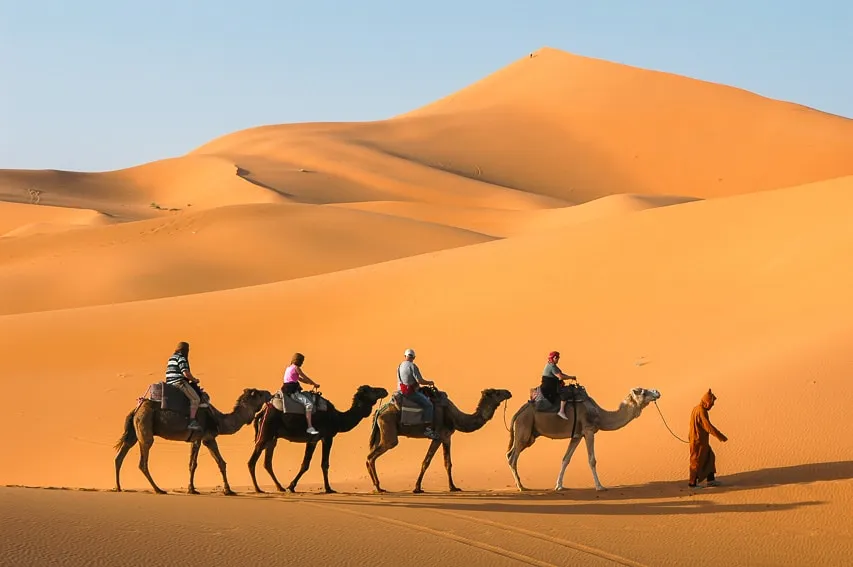
The sequence of experiences at Erg Chebbi follows patterns perfected through decades of desert tourism. Afternoon camel treks depart camps positioned at the dune edge, carrying riders into the sand sea as light changes from harsh midday intensity to golden afternoon warmth. The rhythmic camel gait both legs on one side moving simultaneously creates swaying motion requiring initial adjustment before becoming meditative rhythm matching the desert’s pace. The silence penetrates gradually as riders distance themselves from camp infrastructure, until only wind, sand movement, and camel footfalls fill awareness.
Desert camps accommodate travelers across spectrums from authentic to luxurious. Traditional Berber-style camps featuring canvas tents, communal dining areas, and shared washing facilities deliver nomadic experiences where hardship becomes part of authenticity. Luxury glamping properties offer private tent suites with proper beds, en-suite bathrooms, premium restaurants, and infinity pools reflecting dune landscapes contrasting contemporary comfort against traditional wilderness in ways exclusively Moroccan.
Sunset from high dunes creates experiences that simply cannot be adequately described colors progressing through ranges defying language as the sun descends toward Algeria’s distant horizon while shadows lengthen across sand surfaces revealing textural complexity invisible under harsh midday light. Photographers work frantically while everyone else simply absorbs the visual poetry of light transforming landscape into abstract art.
Evening camps gather travelers around fires for traditional performances Berber musicians playing bendir drums and guembri lutes, creating hypnotic rhythms that seem emerging organically from desert itself. Storytelling traditions, shared meals of aromatic tagines cooked in traditional methods, and the gradual transition from firelight to starlight create progressive experiences building toward the ultimate desert night spectacle.
Erg Chigaga: The Road Less Traveled
For travelers seeking experiences beyond established circuits, Erg Chigaga near M’Hamid offers Morocco’s most remote and authentically wild desert experience. Accessed via the Draa Valley itself an extraordinary landscape of palm oases, ancient ksour, and traditional communities Erg Chigaga requires four-wheel-drive vehicles crossing open desert terrain where GPS navigation and experienced guides prove essential.
The remoteness creates distinctly different atmospheres. Vehicle encounters remain rare sometimes zero during entire multi-day stays. Silence becomes absolute. The scale impresses differently than Erg Chebbi not through individual dune heights but through endless extension where sand sea meets every horizon simultaneously. The experience approaches what ancient caravan travelers encountered, providing historical connection impossible in more accessible locations.
Multi-day camel treks through Erg Chigaga deliver the most authentic desert immersion available in Morocco. Traveling by camel between camps positioned progressively deeper within the dune system, waking to absolute silence before dawn reveals spectacular light shows across dune surfaces, navigating by landmarks and guide knowledge rather than GPS coordinates these experiences connect travelers with desert traditions that modern technology has largely superseded but hasn’t entirely eliminated.
Practical Excellence: Making Desert Tours Work
Selecting appropriate Morocco desert tour operators proves crucial for matching experiences with expectations. Reputable companies employ certified desert guides with genuine navigation expertise, maintain four-wheel-drive vehicles to high safety standards, provide appropriate emergency equipment including communication devices for remote areas, and practice transparent pricing covering all inclusions clearly. Reading independent reviews across multiple platforms, verifying licensing credentials, and confirming guide qualifications separate from driver qualifications distinguishes quality operators from budget alternatives cutting corners on safety and experience quality.
Timing significantly impacts Morocco desert tour experiences. Spring (March-May) and autumn (September-November) provide optimal conditions with moderate temperatures, spectacular light quality from low sun angles, and comfortable overnight temperatures. Summer (June-August) brings dangerous heat sometimes exceeding 45°C (113°F) making midday activities hazardous though dawn and dusk remain spectacularly beautiful. Winter (December-February) provides comfortable daytime temperatures but requires serious cold-weather preparation for desert nights when temperatures can drop below freezing once solar heating dissipates.
Packing appropriately for dramatic temperature ranges remains crucial. Layered clothing systems base layers wicking moisture, insulating mid-layers, waterproof windbreak outer layers accommodate changes from cold dawn starts through hot midday periods to potentially freezing overnight temperatures. Sun protection including high-SPF sunscreen, quality UV-blocking sunglasses, wide-brimmed hats, and long-sleeved light clothing prevents burns that intensify through altitude effects and sand reflection.
Sustainable Desert Tourism and Community Impact
Morocco desert tours generate economic benefits extending beyond major urban centers into some of the country’s most economically marginalized communities. Desert guides, camel handlers, camp staff, local artisans, and transport providers in remote areas depend significantly on tourism revenue that provides livelihood alternatives to subsistence herding or agriculture in challenging environments.
Responsible tourism practices maximize community benefits while minimizing environmental impacts. Choosing operators employing local guides, sourcing food from regional suppliers, using established camping sites preventing vegetation disturbance, and implementing waste management protocols ensures tourism benefits communities while protecting the pristine environments attracting visitors initially. Purchasing handicrafts directly from artisans in desert communities leather goods, woven textiles, traditional silver jewelry provides income while preserving craft traditions facing modernization pressures.
Environmental considerations matter increasingly as desert tourism grows. Vehicle traffic on fragile desert surfaces creates tracks lasting decades where vegetation recovery occurs extremely slowly. Responsible operators use designated routes, minimize off-road driving to essential situations, properly dispose of all waste, and educate travelers about desert ecosystem fragility. These practices ensure future generations can experience the same pristine wilderness conditions that make Morocco desert tours extraordinary today.
Conclusion
Morocco desert tours represent travel experiences approaching the genuinely extraordinary journeys combining geographical diversity, historical depth, cultural authenticity, and natural beauty in proportions rarely matched globally. From High Atlas mountain crossings through ancient earthen kasbahs and spectacular river gorges to the Sahara’s golden dunes, these tours reveal Morocco’s full magnificence while delivering transformative encounters with landscapes and cultures that expand understanding of human potential and natural beauty. Whether choosing brief Merzouga introductions or extended Erg Chigaga expeditions, luxury glamping or authentic Berber camps, standard group departures or bespoke private journeys, Morocco desert tours consistently deliver what the best travel promises genuine transformation through encounters with beauty, challenge, culture, and human warmth that remain vivid in memory long after travelers return to ordinary life.
Key Takeaways
Historical Depth: Morocco desert tours follow ancient trans-Saharan trade routes connecting modern travel experiences with centuries of commercial history, adding profound cultural context to geographical adventure through UNESCO heritage sites, ancient kasbahs, and communities maintaining traditions developed over millennia.
Route Diversity: Tours from Marrakech and Fes offer distinct experiences of different mountain crossings, cultural encounters, and landscape progressions while both delivering the ultimate desert destination, allowing repeat visitors to experience genuinely different journeys through identical territories.
Destination Spectrum: Erg Chebbi provides accessible, developed desert experiences with comprehensive tourism infrastructure, while Erg Chigaga rewards adventurous travelers with remote wilderness immersion where vehicle encounters remain rare and silence becomes absolute.
Seasonal Intelligence: Spring and autumn deliver optimal conditions balancing comfortable temperatures, spectacular light quality, and manageable tourist numbers, while summer extremes and winter cold require specific preparation and adjusted activity scheduling for safe, enjoyable experiences.
Community Responsibility: Quality Morocco desert tours generate meaningful economic benefits for remote communities through local employment, regional food sourcing, and artisan purchases while implementing environmental practices ensuring pristine desert landscapes remain extraordinary for future generations of travelers.
